Thursday, 11 July 2013

Newspaper Unity

All major newspapers in India today concurred on what should be front page news- Convicted MPs must go, by the Supreme Court ruling. 


Monday, 27 May 2013

Doodh ka Daam

Roadside chai-wallah was talking about doodh ka daam during bread-omlitt this morning.. along with news about the heatwave in Bihar. His chai prices change along with this increase in the price of milk.

Significant for me is that I heard about this price rise from him first, and read about it only later in the day on my way home.

Significant also is the effect of doodh ka daam on that tea stall.


Thursday, 16 May 2013

Gangrape accused in "critical" condition, and why we should be critical of the same

It has been five months to the day, since the 23 year old physiotherapy student was gangraped on a moving bus in Delhi. She died two weeks later in a Singapore hospital, from the brutalities inflicted on her.

India then launched into a nation-wide process of introspection, with vociferous protests and even a change in laws related to rape. Also in this period, Ram Singh, the main accused of the six, was found hanging in his jail cell on the morning of 11 March. The case has been abated qua Ram Singh, and the State maintains that he committed suicide, while his lawyer alleges murder. The report on the same is yet to be submitted in the court. Today, the trial finished the examination of prosecution witness 74.

A second accused, is Vinay Sharma. A resident of Tihar Jail 7, he has been hospitalized since 3 May and has thus not been attending any of his hearings since. Now his lawyer AP Singh says that Vinay has been slowly administered "sweet posion" at the jail hospital where he had been admitted for a fever and chest pain and that his condition is "critical."

The case of Vinay requires concern- this is not the first time he has had a serious health issue since the trial began. The young man has had a particularly eventful five months. In March, the former gym instructor announced that he plans on writing entrance exams for the Indian airforce. His lawyer went to the extent of filing an application for him to be supplied with fruits and milk, which the presiding judge agreed to. A day before he was to write his exam, he was found to have a broken hand. He alleged that he had been tortured. The jail authorities said that he got into a fight with other inmates.

This time, Vinay's condition is even more serious. His lawyer reports that on the night of 2 May he was beaten on his chest. "Vinay told me that while beating him, the jail authorities said that they would beat him on his face, but the marks would show, and so decided to beat him on his chest," says Singh. He had been suffering a fever for a few days before that, and this coupled with the chest pain, had him admitted to the hospital within Tihar Jail. Instead of getting better, things got worse. The boy began vomiting blood. His lawyer says that Vinay has been receiving a "sweet poison" in his medicines consistently, since being admitted in the jail hospital. He has been transferred to three hospitals in two weeks and has been vomiting blood at all these places. Singh says that at Tihar and at the second hospital (Deen Dayal Upadhyay, a government hospital), the doctors seem to have made light of Vinay's sickness, calling it just a fever. A bail application for Vinay on the grounds of his ill health has been rejected by the court in Saket where his case is being heard. 

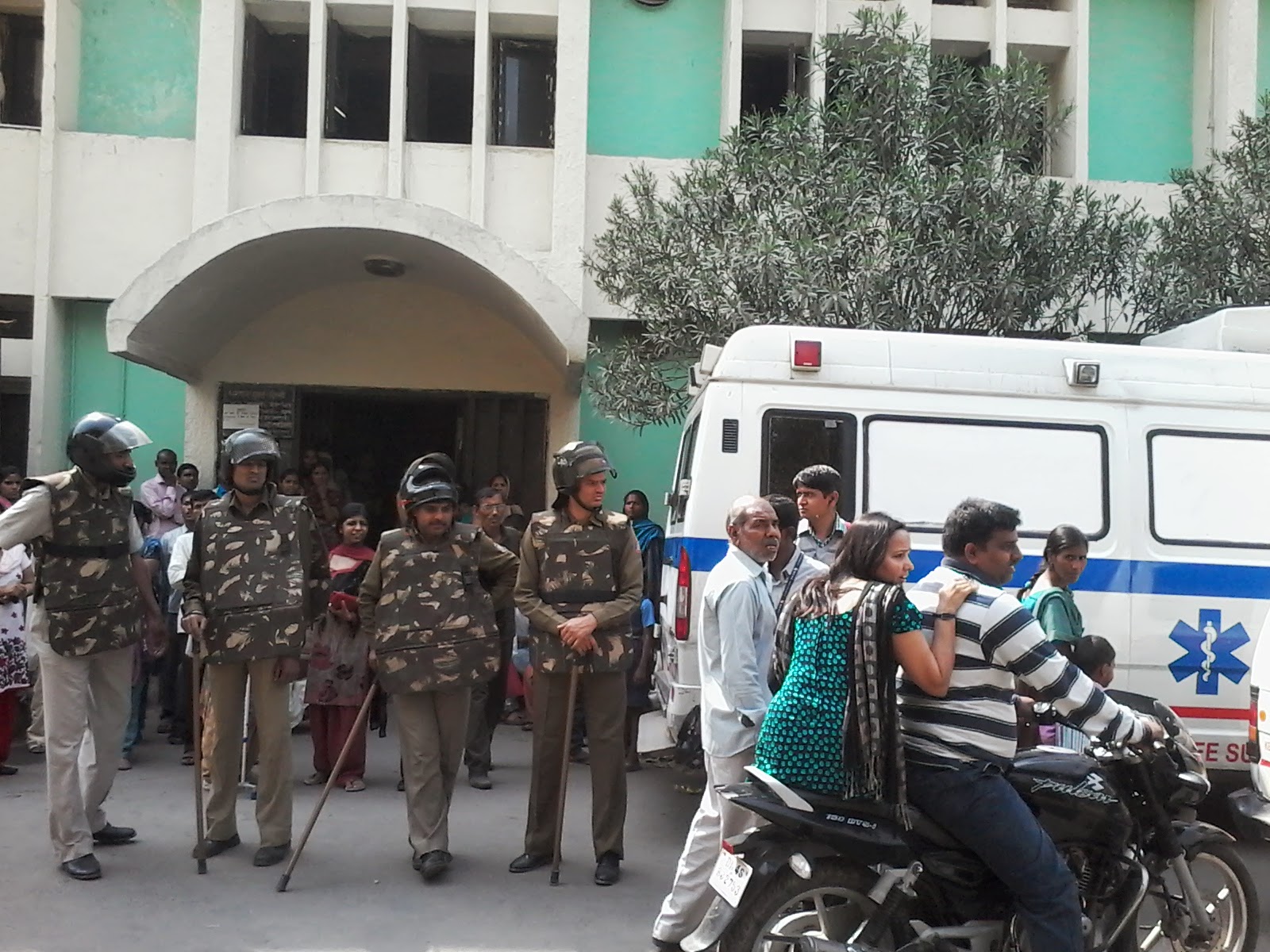
Police wait outside Deen Dayal Upadhyay Hospital, on the day of Ram Singh's "suicide" 

The medical officer at the Tihar jail has submitted a status report today on Vinay. It lists some of the efforts of and opinions made by doctors at Tihar and Deen Dayal Upadhyay Hospital. Tihar referred him to a government hospital citing "fever, sore throat and oral ulcers." The government hospital has provided a "provisional diagnosis of Pyrexia of Unknown Origin with Bicytopenia" and referred him to a third facility (Lok Nayak Hospital, also a government one). In the two days since he has been admitted at what is considered a specialist facility, there has been no accurate diagnosis of Vinay's condition besides that it is "critical." The report is expected tomorrow.

Allegations of torture of the accused within the jail have been made since the beginning of this trial. Akshay Thakur, another accused, has also just last week claimed to have been tortured. His lawyer says that the jail authorities report that he has been bothering other inmates instead.

Of the six accused of her rape, one is a juvenile, which means he will compulsorily receive a very light sentence, and his proceedings are ongoing at the Juvenile Justice Board.

After the suicide of Ram Singh, the sessions court hearing this case ruled for increased security to be given, and for the accused to be treated well so that they do not commit desperate acts that could lead to mishaps. But something is definitely amiss when the accused persons are found dead, with a broken hand, alleging torture, or alleging torture to the extent that leaves them hospitalized for two weeks with no convincing diagnosis. Is it not in the interest of their justice and ours, for them to be kept alive? Or is it normal for undertrials to fall away during due process? If it is, then does it not require critical concern?

Thursday, 14 February 2013

V-Day as D-day, the Fight to Love, and Related Oxymorons

Valentine’s Day, for all practical purposes, is a commercial creation. The day itself does not bear any deep significance to those who may celebrate it, though the love they celebrate might bear some value. Politically and socially, it is a fluffy construct, and should not require too much inspection. But V-Day is D-day now, as far as women’s rights movements are concerned. The day has grown to be important because it appears that there is now a fight on, for the ability to love and express it.  

In January 2009, men from Sri Ram Sena, a Hindu right wing group, barged into a pub in Mangalore, dragged women out and assaulted them. They felt the need to act as vigilantes because women drinking in a pub was unacceptable to them. They then threatened to strike again, on Valentine’s Day. Pramod Muthalik, their leader said, “Our activists will go around with a priest, a turmeric stub and a ‘mangal sutra’ on February 14. If we come across couples being together in public and expressing their love, we will take them to the nearest temple and conduct their marriage,” If there was resistance to this by the couple, the girl would be made to tie a rakhi on the boy.

In the “WTF History of Indian feminism,” this incident has a chapter. When a social class is faced with such ridiculous opposition, the only way to respond to it adequately is with irreverence. This explains the ingenuity of Slut Walk. In this case, a fitting reply was provided by the ‘Pink Chaddi Campaign.’ A bunch of women got together, and decided to send these saffron-chaddi men, some pink underwear. The aim was to flood the Hubli office of this group with mountains of panties, by Valentine’s Day 2009. And this has made a permanent X-mark on 14 February, on the activist calendar.

The ‘Consortium of Loose and Pub Going Women’ was started, and with a hark back to Gandhi’s ‘Jail Bharo’ campaign (which was invoked even recently during the Anna Hazare agitation), women pledged that they were going to go to a pub, and have a drink. Their slogan was, ‘Pub Bharo.’ Muthalik replied to the women by saying he would send “1000 sarees as return gifts” for the chaddis he receives. By Valentine’s Day, he and about 140 of his goons were taken into preventive custody by the police. Hundreds of chaddis awaited him in his office.


Loving is a hard thing in India. People get killed for loving of their choice. And so we have honour killings, where communities kill their own for eloping or marrying out of their caste. Or fathers kill themselves when their daughters transgress caste lines by loving, and this inflames entire communities, as in Dharmapuri recently. Or for the more ludicrous, police in Bangalore have been intimidating young couples by video taping them while they spend time with each other at public places. 

I want to take the liberty to say that the 16 December gangrape in Delhi, and the subsequent death of the victim, can be seen from some distance, as a wave in Indian feminism. We can see a line from 14 February 2009 to 16 December 2012 to 14 February 2013. Since the rape, there have been massive protests in Delhi, which made history when they reached Raisina Hill, in a country where police permission is required for protests and protests are only permitted in designated areas. Protestors were subjected to water cannons and tear gas. The protests were spontaneous, lacking in leadership, and were united by pure outrage. Important dates that came between 16 December and 14 February, have all seen protest as a response to celebration, including Christmas, New Year and Republic Day. People are still at Jantar Mantar in Delhi, everyday. Some have been fasting, some have set up camp. 

Since then, fast track courts have been set up around India, to deal with long pending rape cases. Life imprisonments and death sentences are being doled out, perhaps in response to the vociferous and dangerous public outcry for the same. The winter session of the Parliament closed with no closure on the Criminal Law Amendment Bill 2012, which sought to deal with many issues of violence on women. The path breaking report by the Justice Verma Committee was released on time to widespread appreciation. But the government came out with an ordinance that instead of heeding the prudent Verma recommendations and placating people, has made them more angry due to its haste, ill thought out recommendations and secrecy. At the impending budget session of Parliament which starts on 21 February, activists are pledging that they will keep a watch on how the government allocates funds, and if any will be spared for safety of women.

It is in this ironic period, that Valentine’s Day falls. It has been four years since Pink Chaddi and 14 February, is hardly a fluffy day anymore. It is a day of strategic importance to the women’s movement. It is a day for deep social introspection, the kind of stuff to be philosophized about in academia. For the young people who do celebrate Valentine’s Day, albeit an urban young India, it is now a significant day to reclaim their choice to love and express it and their freedom to live fearlessly. By extension, it is a day to resist moral policing of this expression and sexual violence. This “western concept,” which angers Indian conservatives so much, has been made quite personal to Indians, something the conservatives did not foresee.

Globally as well, this day, this year, is significant because today is when one billion people are expected to “strike, rise and dance” as part of the One Billion Rising campaign. The campaign was started by the very famous Eve Ensler, author of Vagina Monologues- a hit play where each of the monologues deals with different aspects of the feminine experience. The campaign is premised on the realisation that one in three women will be raped or beaten in the world, in her lifetime. This makes one billion women. The movement is asking women and men who support them, to rise, on this "V-Day" and take to the streets and dance. 

The global support for this cause comes at the right time for India, and there are about five different events happening in Delhi alone. The biggest is happening at Parliament Street from 5pm todaywhere the entire street is going to be occupied with singing, dancing, posters, photo exhibitions, street plays, art installations and other innovative interventions. Other events are happening in Kolkata, Mumbai, Bangalore and Hyderabad. Make it to a rising in your neighbourhood, or organise one yourself, for the freedom to love and be fearless.

Tuesday, 2 October 2012

What Would Gandhi Do?

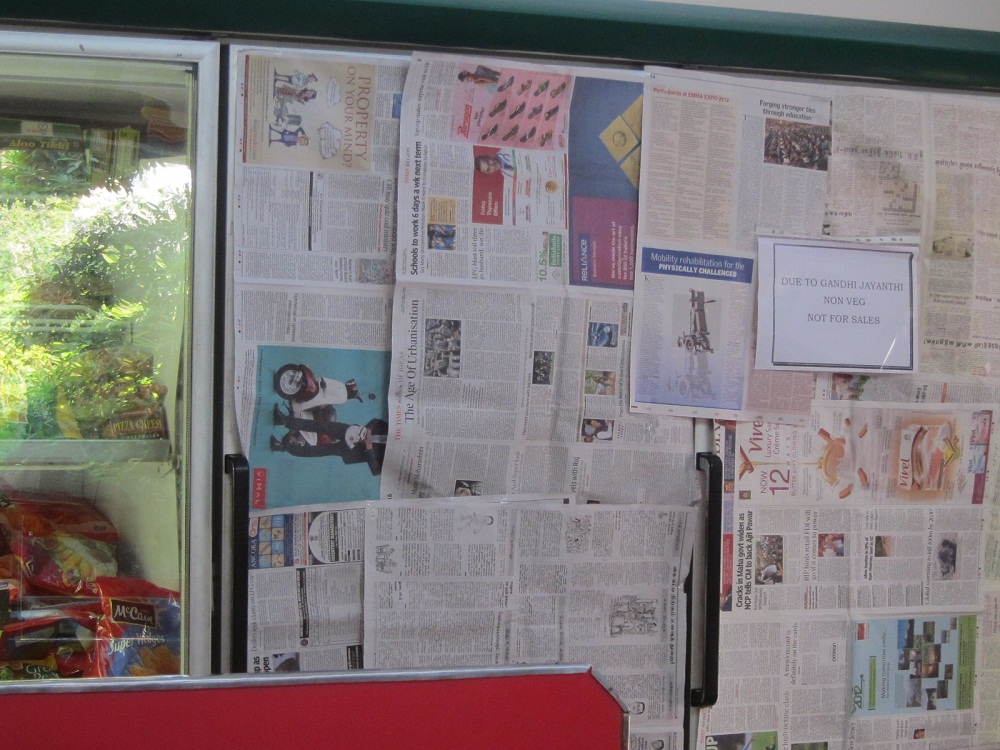
Today at a supermarket, I saw that the entire freezer section was covered in newspaper. A sign on it said, “Due to Gandhi Jayanthi, non-veg not for sales.”


 A “foreign hand” wanted to know if this was normal for India.   

It is. India saw a “beef-eating festival” earlier this year to counter this anti-meat-eating movement (fielded by the right wing, supposedly for religious reasons and/or animal rights and/or “good nationalism,” but accused of doing it to push around an anti-non-Hindu feeling. Many negatives will not make a positive in this country.)

(The beef-eating festival is for real, and truly I imagine, a day will come when Falafel will be banned in schools.)


I had not noticed the meat-moratorium earlier, but it is possibly because I never went grocery shopping on Gandhi Jayanthi (ie: today, Gandhi’s 143rd birthday). Gandhi ate no evil and drank no evil and as such, his home-state of Gujarat is now a “dry-state” and his newest “avatar,” Anna Hazare, apparently follows this approach in his hometown of Ralegan Siddhi, which Ramchandra Guha writes about, “he found the approach of Anna Hazare“deeply brahmanical”. Liquor, tobacco, even cable TV were forbidden. Dalitfamilies were compelled to adopt a vegetarian diet. Those who violated theserules — or orders — were tied to a post and flogged.”

What would Gandhi do?

Gandhi is widely quoted to have said, “The greatness of a nation and its moral progress can be judged by the way its animals are treated.” 

I am widely quoted to have said, “You can’t/ shouldn’t care about environment and stuff if you don't first care about humans.” (This is open to misinterpretation.)

And as Gandhians, we treat his words in a static way, even while our sentiments are ironically pasted on a backdrop of newspapers. Keep with the times, G. Stay ahead of it even. 

Tuesday, 31 July 2012

G-aping Instead of Acting: Photos from the 'Silence is Violence' Protest Against Sexual Abuse, Bangalore

A young girl is beaten by a mob in Guwhati, India. Don't think “dark alley, no people, underdeveloped area, skimpy clothes.” Think “public place, city, media coverage, the works.” Women in India are subject to a number of ingenious abuses- from dragging them naked through streets, to kicking them to death for having a girl child, to locking up their vagina with an actual lock and key, to female foeticide, to dowry related deaths, to caste related murders.

The recent incident in Guwhati brought people together in protest across the country. Local residents put up pictures of the molesters on hoardings. The “Silence is Violence” protest in Bangalore aimed to turn an idea famously associated with Gandhi, of “seeing, hearing and speaking no evil,” represented by three monkeys in a row, towards a post-Gandhian way of looking at it- if you are silent to a crime, then you are an accomplice.


(For best results: Click on the slide show above. It will take you to the album in which you can view the photos full screen.)

Where does the problem lie? With men? Or is it patriarchy in general, which need not be a gendered activity? Could the women then be faulted for perpetuating the system? Or is it the society at large that makes the system seem imperative? Is it the lax process of law? Or the media that can be insensitive to issues of sexual violence? Or bystanders, who witness violence and do not speak up?

I joked with some of those gathered at the “Silence is Violence” protest, that maybe “We should also take off our clothes.” The drum beats were catchy and people were tapping their feet. One lady asked another, “Do you want to dance?” The other lady replied, “We will be back protesting a lot more if we dance and anger the other protest-groups.” The irony runs deep.

Wednesday, 27 June 2012

Flipkart and Arundhati Roy, Gandhi and Tendulkar

Darling e-commerce website Flipkart.com has been in a spot of discomfort lately with a Forbes article cover-story that has just come out about its apparent/ impending fall. The story itself is not yet online but an exchange between Sachin Bansal of Flipkart and Indrajit Gupta of Forbes India is. 

First thing's first: I'm a fan of Flipkart's service and wish that such a tragedy does not occur.

Second things second is a bunch of observations I made while adding to my wishlist on the website.

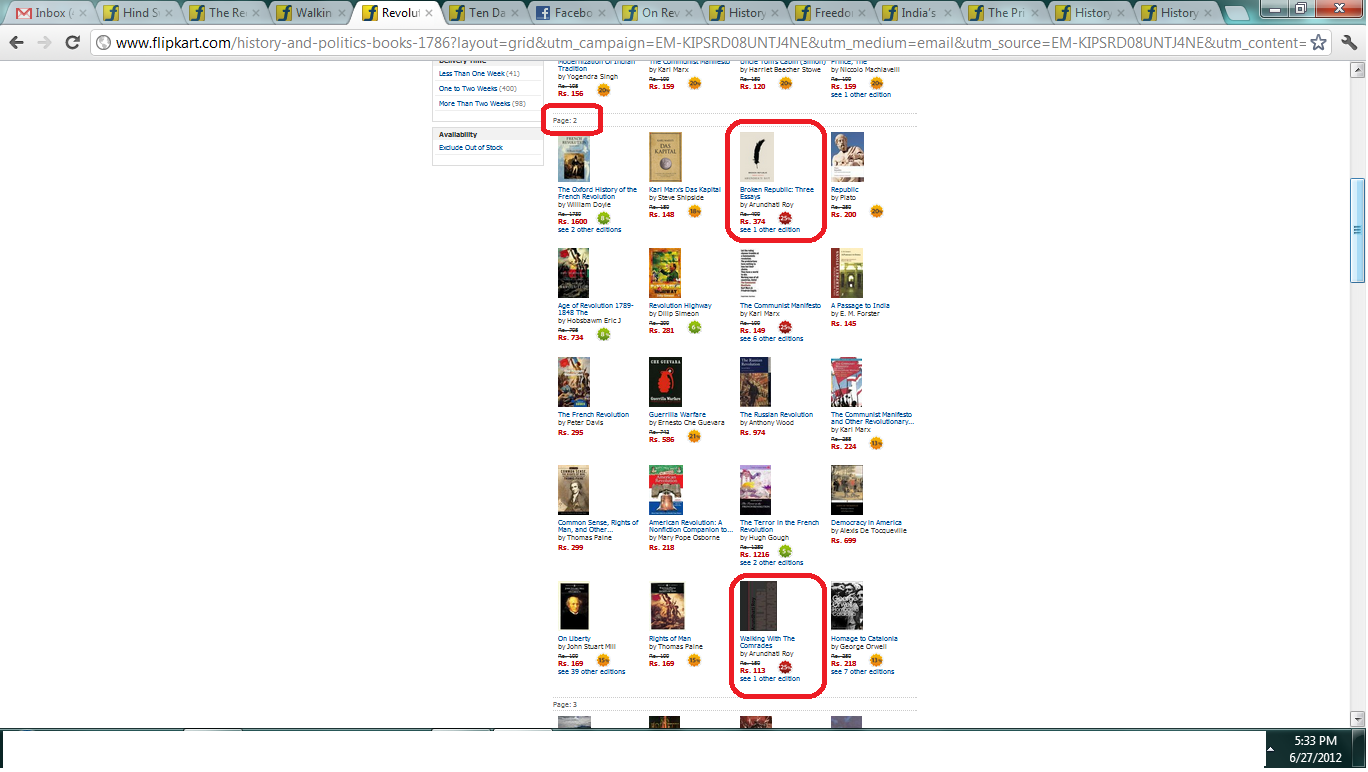
Observation #1- Arundhati Roy is right up there with the big guns. Two of her books, are on page two of the "History and Politics" classification.. along with nice gentlemen such as Marx, Paine, Mill and Orwell. Fancy. Based on popularity or classicality or what?


Observation #2- Hind Swaraj is selling for as much as Rs230. Well, you can also pick up a brand new copy for Rs10. My ten rupees copy says, "Price of this book is subsidised by the Navajivan Trust." This is true for a lot of political literature in India- head out of Flipkart for the same, and pick up cheap paperbacks with nondescript covers, printed on much recycled paper.


Observation #3- Sachin Tendulkar is "is the only cricketer to accomplish the feat of scoring a hundred centuries in international cricket which includes 49 ODI and 51 Test centuries." He is also "the first active sportsperson and cricketer to have been nominated to the Rajya Sabha." Now, Flipkart is happy to announce that he is also a genre of books.


He is modestly under "See more" and towards the end of the list. But he still is above tags of vital importance such as "Travel" and err.. "Sports and Games!"


To introduce some scale: "Academic and Professional" is one of the largest categories on Flipkart, with 706365 titles. "Literature and Fiction" is next, with 586608 titles (I've left out the largest "category" on Flipkart which is called "Print on Demand" and has 731713  results.. I'm starting to think that Flipkart has mixed up their "tags" for their "categories" that are ideally "genres"). The "Sachin Tendulkar" category however, has only 15/ 17 titles (there is some discrepancy on the website, as indicated in the pictures). The next smallest category has 77 titles, and is called "Skill Building & Learning Books." I can flog this further, but I'm stopping now. Funny huh.

"The country" is currently trying to pick the "Greatest Indian after Gandhi." Tendulkar is on the short list. Looks like we all know who Flipkart has voted for!

Sunday, 10 June 2012

Reflections on Urban Protests, Public Engagement, Mainstream Media and Social Media


The lifeline of small, urban protests today, is the Press. From my observation, this seems to be a trend. I found this to be true of the Anonymous protest  in Bangalore (and  in other parts of the country like Kolatta, from my readings) as well. Please note that by virtue of this post being about urban protests, I am talking about the communication technology enabled Public and Protestor. Much of this post takes from the fresh experience at the Anonymous protest in Bangalore yesterday but it has evolved out of engagement with several other such events over a long time. It might make sense to read my previous post, before this one.
I’ll proceed by first setting a context.

The Aim of a protest is many fold and usually all of these reasons below, no matter what method is employed-
  1. Awareness to the general public of the cause
  2. Awareness that there is work being done on the cause
  3. Mobilising the public
  4. Effecting change at the policy level
Largely, it is Public Outreach work and Policy Work (Advocacy and Lobbying). Another way of looking at it is that there is work that happens at the Grassroots and other work that needs to happen with those in the Ivory Towers. Most organizations, formal or informal, work on the first three Aims, with a Grassroots engagement. Very few work at the Policy level. They are usually less well known, quieter in their methods, and involve more information than that which floats at the Grassroots.

“Let’s Bring the Change” rhetoric works in a few different ways. Sometimes it concentrates solely on the first three Aims, if it is an issue solvable by the common man. For example, “Let’s stop littering our surroundings.” Other issues cannot be solved by the common man, and so Mobilization becomes important only to show policy makers that there is now a democratic mandate for the change in request, such as, “Let’s remove fuel subsidies for businesses.” In this case, the first three Aims are optional to fulfill and if they are fulfilled, its only to reach the fourth. Other issues need a partnership of common people and policy makers, in which case the protest should ideally try to fulfill all four Aims. For example, “Let’s end caste discrimination at the work place” is an exhortation to employers, employees and the government to put in effective laws.

Now with regards to the first three Aims specifically, and the fourth one by trickle down, here are the Methods that concerned individuals use to realize their Aims.
  1. Connecting to the “man on the street” (which includes ALL types of people. At least a protestor would hope so. Ideally, the protestor should try connecting with the man he may not normally be able to interact with), by protesting in public
  2. Connecting to the man in the virtual armchair, by using social media
  3. Using mainstream media to be the one stone that gets both birds above (The man in the arm chair can also be the man on the street, but the assumption is that it need not happen the other way around, and thus it necessitates a public demonstration)
The problem with Method ‘a’ listed above is that, the man on the urban street usually only stares. Ive been involved as spectator, skeptic and participant at a number of social justice events and I have almost never seen people walking up to social workers, and asking for information. Social workers on the other hand will try and go to the people, by shouting slogans, holding placards with thought provoking statements or handing out flyers. Yet people are in a hurry and seem to feel comforted by the rationalisation that “There are some good people in the world. Their energy can offset my apathy” and leave. I can only once remember a passerby, who stopped to see what was up. Correspondingly, people who attend social justice events, are nearly always members of the organizing group, members of related invited organizations, and other regular faces involved in the cause in question. I cannot remember meeting a brother, sister, mother, friend or cousin, who wanted to “learn more” or “find out how they can support the cause.” Maybe it is not that we are apathetic, but that we are acurious.

The protest of yesterday, employed Method ‘b’ first, Method ‘a’ next and Method ‘c’ last (as do most protests that work with Web 2.0). At MG Park, protestors were looking around shiftily and someone suggested shouting slogans. It didn’t look like anyone was going to take the initiative, neither did it seem like anyone could think up a smart slogan. Besides, there is the futility of shouting at traffic to consider. And in the case of this protest, the masks were effectively muffling speech (not to mention vision and breathing as well). At FP though, there was slogan chanting. But the protest area in FP is flanked by wide borders of parking space, a line of trees and a footpath. Once you cut through all the thicket, you arrive at a high speed road, with the nearest traffic signal being about one kilometer away and so vehicles are whizzing past (which does not actually happen in other parts of the city where roads are bad, vehicles are too many, signals are frequent and traffic crawls). No man on the street heard the slogans or read the thought provoking placards. No unaware person was made aware, no uninitiated person was mobilized. It was a protest/ awareness drive that was self contained among those who are already aware. The hope of a TV channel or newspaper reporting it was really the only way any kind of un-aware person could become slightly aware. And perhaps this was the goal.

What happened during the public demonstration was really, only an exercise in pandering to the media. Protestors did not actually reach out to the man on street at all. Protestors came, they were photographed, they left/ got lost. Methods ‘b’ and ‘a’ were really an elaborate lay-up for the execution of Method ‘c.’ One consolation perhaps is that the masks prevented gloating. Had there not been masks, all the weary twenty would have wanted in on the frame.

Awareness of the cause, the work being done and mobilisation, was all communicated by the Method of the internet. The public protest was not to connect to the public directly, but was a show of strength so that the mainstream media, the intermediary (to use relevant jargon), the amplifier, would do the hard task of letting the non-web savy person know of the cause, the work being done on it and mobilise. To put it easily, all the first three Aims of a protest that I had listed above (and the fourth one as well, by extension), are being taken care of by the third Method of protest.

To further put this trend of small, urban protests in perspective, is that fact that internet penetration in India is currently onlyat 10.2%.

Does this b->a->c practise harm anything? Information is still getting out there, fulfilling all the three Grassroots Aims. People on the street also probably read the newspaper or watch the news on TV. So even if no one bothered to hand them a flyer, or they have not been part of the process online, they are still initiated into the awareness process. What initially targeted only 10.2% resulted in the rest of the connected populace being put in the loop. When more people are aware, the trickle starts flowing down and the fourth Aim of effecting public policy gets underway. This is even without the help of those who work with the Ivory Tower residents. All in all, it seems like a very effective way to get redressal to a cause. Especially when the man on street is also acurious.

And thus online or offline, high turn out or small turn out, if mainstream media covers it, a protestors work can be said to be “done” and a cause nearly accomplished. Shout slogans for the mic, raise placards for the camera, go home and wait for the evening bulletin. Do whatever you have to before the media arrives, to ensure that they do arrive. Breathe easy once they do. At least at the end of this, you Protestor, will have a link to post on your website. The next time you make a presentation to seek donations, you can use the line, “Several national dailies wrote about our struggle in xxxx to do xxxx. It was well covered by both television and print media.”

It thus seems that the quantum of protest does not matter in this form of urban protest. One does not need to protest long durations of time. One does not need to make a “large human chain.” One does not need to baptize five hundred new people into the fold. One only needs to get ten people together and the photographer will fill the frame with ten people (better if it is an aerial shot) and the reader of the newspaper will imagine that there were at least another hundred people packed behind those ten.

It is this argument that I would also like to claim as my response to the Reuters report that came out yesterday on the Reuters blog. The article seemed to poke fun at the grandiosness of the Anonymous movement and display it as lame, with the blog’s inverted commas, embedded links and second comments. While I am not an Anon nor do I wish to be one, I would like to prop up the argument that the protest was not about connecting with the people on MG Road, or about showing up in large numbers (which the article is taking for granted as markers of a real protest). The protest was an attention seeking stunt. This is Anonymous’ selling point. And this is exactly what they achieved. So the Reuters talk-down of the protest is really, so irrelevant to Anonymous. Those who did not attend or did not support the movement at all, may enjoy what they consider a barb to Anonymous but to them, it will bounce off with no mark (Also because there is no known horse to flag).

--------------------------
Is there a way protests around the world should change in their approach? Consider all the parties involved- the protestor, the public, the media, the state. Do share your views in the comment section on this post. 

Anonymous Protest on Web Censorship, Bangalore: Report


How often do you get to wear a mask and parade around MG Road? Only on 9 June 2012. And so I was there to check out what Anonymous is going to pull in Bangalore, with their all-India call to protest.

In May of this year, there were a few protests around the country against the IT Rules. These events were largely conducted by organizations working closely with policy in the country. Then a corporate had the gall to censor free speech in India- Reliance blocked file sharing websites of various orders. State censorship/ protection of people is old news and we are somewhat ready for it, know what arguments to expect from the government and are already prepared with rebuttals. One can see sense in the government’s argument that excessive mouthing-off can harm sections of people whom the government is responsible for. But now a corporate dared to censor free speech. And for its own economic ends. How dare it! With the plug pulled on the high seas of the torrents, young people everywhere suddenly had no time-pass. With no more television series to download and watch, they got together and we began hearing of Anonymous attacks on government websites.

At the protest in Bangalore, yes organisation was absent, attendance was a sprinkle, and more attendance was lost because of the first reason. We are all used to being told what to do, and so not having a leader was a new life experience for most. But protesters finally found each other, and managed a sizeable number at Freedom Park (FP) by the end of the day.

The plan was to meet up at various metro points in Bangalore, and congregate at the central station at MG Road. There were a few people sitting around, and everyone seemed to be giving each other a longer and harder look than usual, but no one knew what to do. Then some boys began unrolling large posters and soon there was a group of about 15 protestors around them, and even sooner, did the photo session with the Press begin. Masks were put on in a hurry, posters were displayed, and protestors stood in a small huddle for the camera. Some people just dropped in and left immediately after the photos. Then in about ten minutes, everything and everyone broke up. “Where did they go? Do you know what to do? Where should we go now?” One group chugged off down Brigade Road, a legally unacceptable place to protest in Bangalore. Another group set off to the MG Park, the formal designated area for protests in Bangalore. Still others were pondering heading to FP- the newly created protest destination in Bangalore, and the only place for which there was alleged permission for the protest. Apparently the bulk of the Press had landed up there, and the protestors hadn’t.

This is Good-Anonymous in action, from my readings of it- people take charge on their own, and don't wait around for someone above to tell them what to do. To this extent, this was positive action on the part of the protestors who really had nothing to hold on to. In case of any untoward event, protestors would not even know who their comrades were, what with the masks and bandanas, yet they chose to do the illegal and protest together (protesting without a police permit is illegal in India) (Im not endorsing illegal activity of any kind =/).

At MG Park, protestors were largely vacant and generally hanging out. Yay for masks, or else major lameness shall have been felt. It was photo-sesh for Facebook and making comments to a few irritated Press people who were at the park. “Don't you have a phone number?” they asked. To which the general response was always, “We are Anonymous *sound of wind blowing*” Which really did not answer their question and they continued to be annoyed and huffy. A number of protestors were lost along the way- they had gone to take photocopies of the Guy Fawkes mask =/

A roly-poly cop turned up. Walkie-talkie was the only betrayer of his possible police connections. He asked the protesters to show their permit or leave. One of the alleged Anons talked to him and soon the cop was laughing and amiably saying something like, “No problem, just go to FP.”

A kind lady then came from the FP protest to inform the MG Protestors to move to FP where there were more protestors and Press. FP was a better idea, as there was more scope for symbolic action. There were about 80 protestors in total. Feeble and disorganized chants were made sporadically, led by a diminutive girl in a blue scarf. Protestors were not sure whether to follow the call-and-respond method or the fill-in-the-blanks method. Since different people tried both methods and filled blanks differently, it was a general rumble. A “protest auto” arrived, and some unmasked gentlemen began making speeches through a mic, amplified through the speakers mounted on the auto. The mic was passed around and others sheepishly made their statements about free speech. Someone began telling people to disperse because some cops were getting itchy. The sun set.

The pre and post parts of this protest were orchestrated via a Posterous page called ‘Operation India’ and Facebook events. Several people were unhappy at the events in India being called “Occupy.” For some, “Occupy” spells much hope from images we saw over the last many months. For others, “occupy” is but a generic protest buzz word. I see this point but find it futile to harp on the semantics of ‘O’ versus ‘o’ with a bunch of people who clearly have their heads in the cloud (Geek PJ, gimme some!). A few hours before meeting time, one possible Anon frontman posted on Facebook, “This is not a protest, it is OCCUPY.” When quizzed about it, he made no sense. At the protest, when asked about it, he made no sense either. He repeated the same statement a few times and said, “If you want, you can call it protest but if you want you can call it occupy but we are saying it is different. Occupy is not a protest. Like Gandhi’s work of civil disobedience, was not a protest. Like that, we are not a protest.” Whatever that means, but it apparently does not matter. Maybe it was his strategy to weasel out of a police confrontation- by confusing them. It could be that these guys are going for, "Lets Occupy India by Anonymous tactics and... if there are any more buzz words, lets use that also, maybe we will trend on Twitter with one of these tags.”

There was also some politics with the initial event being cancelled and viewers directed to a second page, though only the first page flourished. No explanation was given for the same, and it only added to the general confusion that happened online and at the protest.

Those who didn’t show up were termed “Dickheads” by a distinguished looking Anon gentlemen who stood apart from the protestors, at FP. He had come in full costume- black suit AND mask. The FSMK organisation in Bangalore that has really been doing a lot of great and sustained work, was termed “FUCK” and declared unwanted (because they did not wear masks and distributed flyers). People who queried his beliefs and statements were called “bitch” and “idiot” “who hasn’t watched the movie V for Vendetta.” (This was indeed the prescribed educational potion by the smug Anon). Spurning people who may actually be interested in Anonymous’ aims of free speech, strikes me as an immature idea.

The arrogance and heavy-headedness was displayed in other ways as well. One of the alleged and self-proclaimed organizers asked someone if she would like to work on phase two of the Operation. He tried to find out who she was and other personal details. When she did not freely give the information, he said, “Ill dox you. . Ill find out your personal data from the internet and dox you." =/ Well, nice of you to use your technological weapons for personal vendetta.

There seemed to be a general low level of comprehension of facts and debate. Instead there has been much trolling and repetition of rhetoric in mindless and juvenile fashion- “We are legion, we do not forget, we do not forgive” etc etc and this was often the response provided to any statement!- save two people I talked to online. All the rest who seemed to be vocalizing their feelings online had nothing to say when asked about the cause, and got defensive in juvenile ways when faced with opposition.

Though this is common to thousands of online forums, if this is their idea of free expression and dialogue, then OpIndia and I have some ideological problems. Anons are currently riding on the cockiness that comes with the new found use of their technological prowess. Since Anonymous is a group that has no moderator or rules, people can actually get away with saying anything, doing anything, believing anything and convincing others to believe in anything. Individuals who mislead can become representative of Anonymous and take from whatever good that they may be planning. Being a pain online is no big deal. But it becomes important here since the identity of the organizers is unknown, work is predominantly done online, and it could be these painful folks who will be doing the next DDOS attack on their half baked rationales and feel like heros. With no surety of legit and troll, I am concerned.

As a side comment, I also found it interesting how the self-important Anons parading on the Indian pages could not catch irony or sarcasm or even general humour. Which is really quite terrible if you want to be an Anon since Anons have always tactically thrived on satire (and drama). 

Monday, 28 May 2012

Bad Biscuits

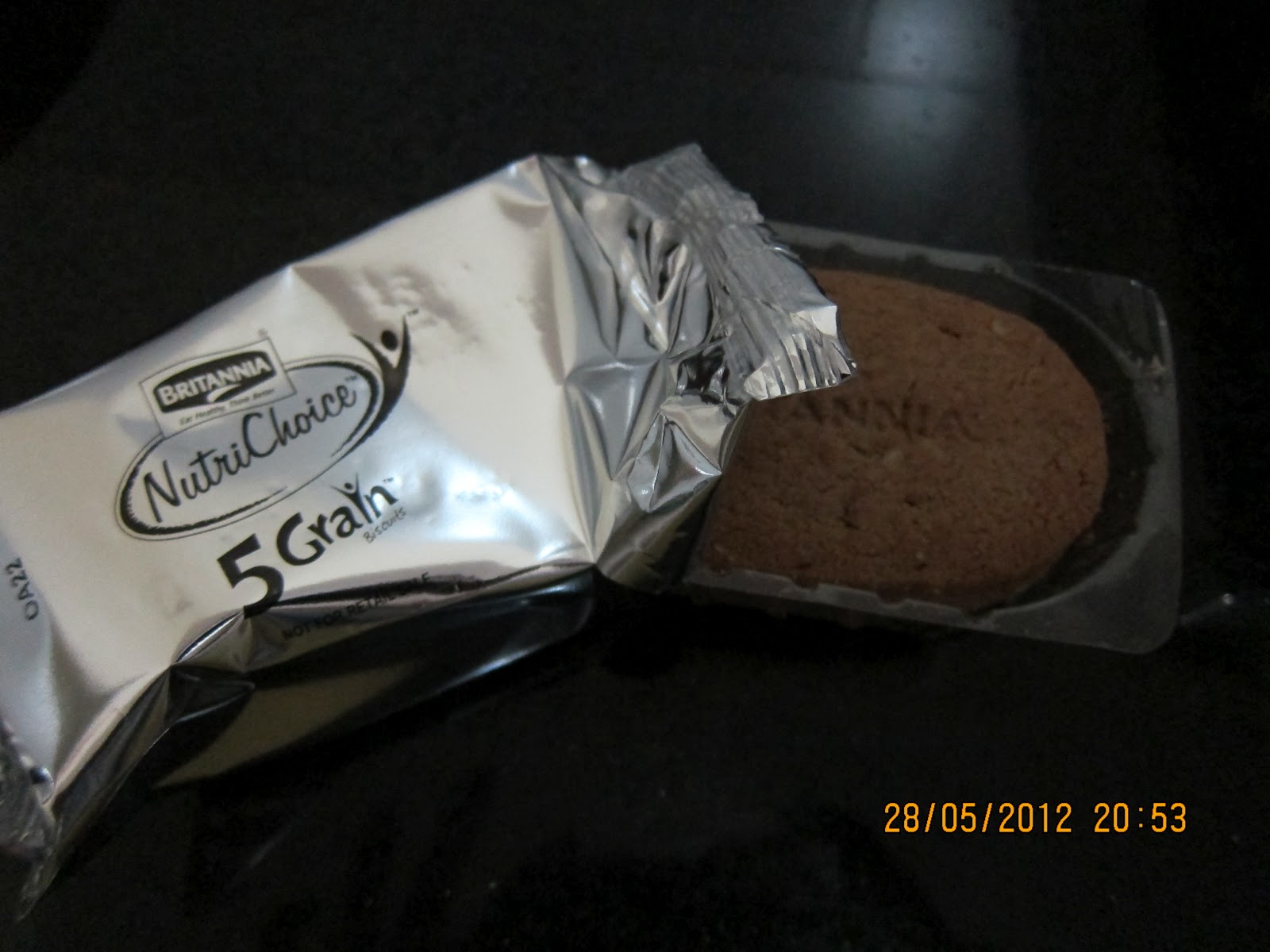
Guilty pleasure. No. Just plain guilty. Nutri Choice is guilty of unnecessary extravagance.


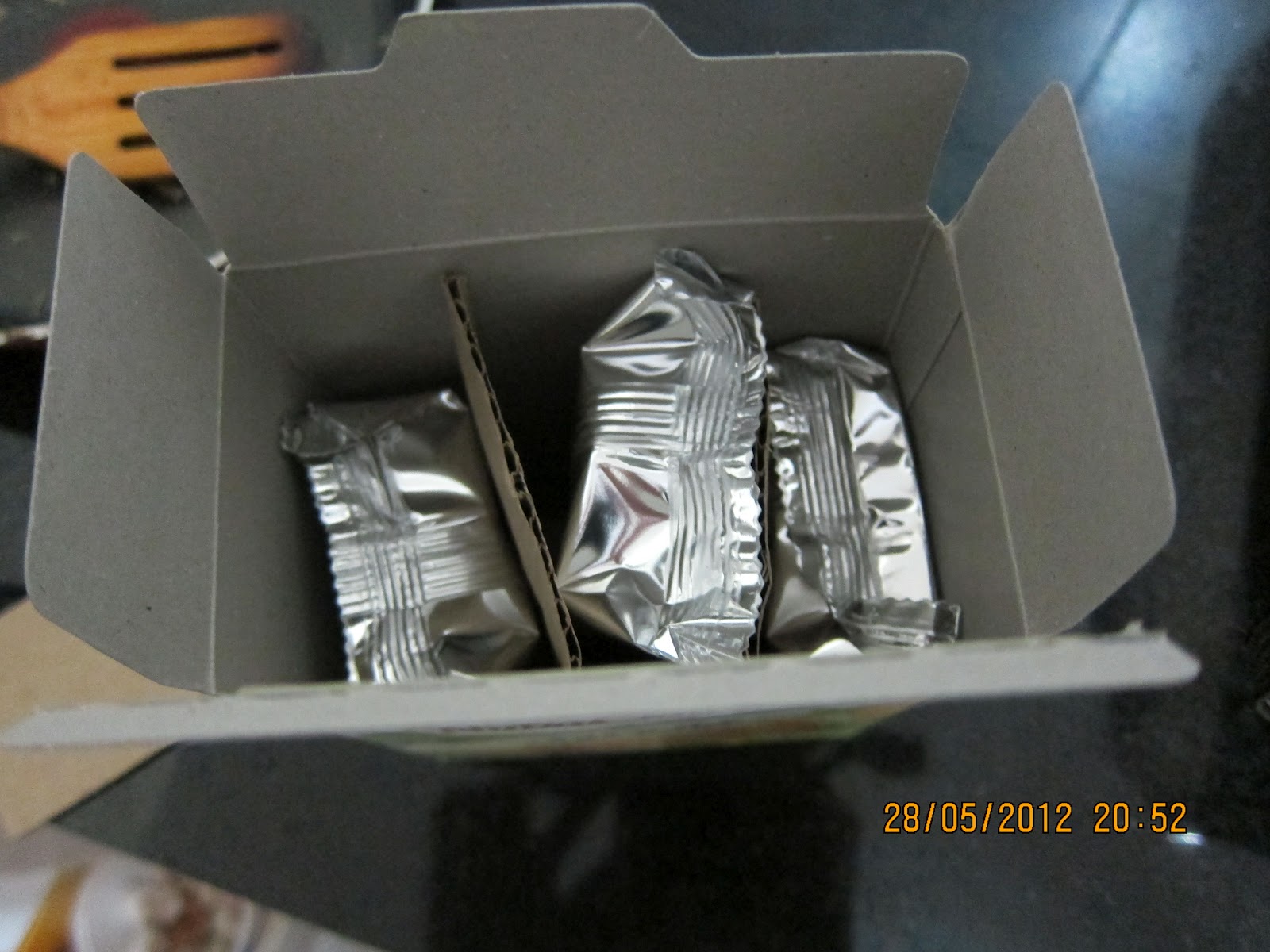
You open it to see this. 


It's like an MLP- Multi Level Carpark. Learnt the acronym from corporate friends this week. 


This is what an individual packet of biscuits looks like... from the outside =/


And then, when you FINALLY make a sighting of your damn biscuit... that is after all going to taste only like cardboard... more packaging =/


Saturday, 21 April 2012

FoE: 2011 to 2012 and whats happening in India, April ‘12

Its been a little more than a year since the seeds of democracy began pushing out of the dirt and protests bloomed across the world, in what we called the Arab Spring. The Protestor was the Person of the Year, in 2011. The internet established itself as a force to be reckoned with.

It is more than a coincidence then, that 2012 is rapidly snowballing into the year of Containment. ACTA, SOPA, PIPA, CISPA are working over-time to draw in the nets of freedom of expression (FoE). Governments everywhere, seem to be responding to 2011’s vocalization of dissent, with a gag order on free expression. Look how far we have come from last year's clenched fists to this years cowering.

By April, we have already seen Wikipedia register its protest with a blackout of its English services. Apart from the drop in academic productivity on that day, Wikipedia's symbolism was deep- can we imagine a world without free information. Would we like to?

In India

India saw a peculiar protest in 2011. Anna Hazare’s fast to protest corruption, was powered by web 2.0 but employed 1947 tactics. And it worked. By 2012, the Indian government is hitting back, much like its contemporaries around the world. The new rules they are pushing are not very dissimilar in intention from its global relatives. They introduced the Information Technology Rules 2011.

A few years ago, several things flew under the radar, but come 26/11 and India stepped up its surveillance in many ways. The internet’s formlessness began to be institutionalized. Cartoons Against Corruption whose head rolled as a result, is one such example. The website was suspended. This kind of banning can happen as easily as ordering a burger and fries if the IT Rules come to pass.

On April 11, 2011, the Government notified the new Information Technology (Intermediaries Guidelines) Rules, 2011 prescribing various guiding principles to be observed by all internet related companies. Government has enacted laws that gives it a free pass to censor our Facebook posts, listen to every Skype conversation we have, monitor our tweets or blogs or access private photographs and documents we store online, or track our location using our mobile phones or survey all of your online activity. [Friends Of Internet]
There are a range of reasons why the IT Rules are extremely problematic. Anyone can file a complaint with an intermediary, such as Facebook, Google or Yahoo!, about content they find, among other things “disparaging”, “grossly harmful”, “hateful” or “ethnically, racially objectionable”. The company has to act on the complaint within 36 hours. The initial poster of the content need not be informed about the complaint or the fact that his or her content has been taken down. And an appeals procedure is not provided. Why is all of this problematic? For one thing, terms such as “disparaging”, “grossly harmful”, “hateful” or “ethnically, racially objectionable” are extremely vague and in many cases not part of Indian jurisprudence. It’s thus difficult to decide when they apply to a particular tweet, YouTube video or Facebook status update. It could also well be argued that these terms entail restrictions on freedom of expression that go well beyond what the Indian constitution allows for. In that sense, they have the potential to significantly harm the right to freedom of expression of India’s one billion plus citizens. Moreover, when a complaint is filed on the above grounds, it is not the Indian courts who will decide whether or not the complaint is legitimate: it is private companies such as Facebook, Google and Yahoo! who have to do so. And their first interest is not your right to free speech, but their profits. As a consequence, when these private actors need to take decisions such as these, it is likely that they will err on the side of caution, thus further aggravating the chilling effect on free speech these rules will have. Yet when someone believes their content has been taken down for the wrong reasons, the rules do not provide a mechanism for them to argue their case. The only recourse they have will be to go to court – a process that takes money, time and other resources, and thus for many people is an intimidating prospect. [Internet Democracy]
Its all going down this April
Parliament Session
The annulment motion is going to be discussed in Parliament on April 24, 2012. Before this happens, there are a few events happening around the country, aiming to get more information out, register dissent and pressure MPs.
Bangalore
The Centre for Internet and Society and the Foundation for Media Professionals is having a discussion on 'Resisting Internet Censorship: Strategies for Furthering Freedom of Expression in India,' today, April 21, 2012, 2pm to 6pm at the Bangalore International Centre, TERI Complex, Domlur Stage II.
Friends of the Internet is holding a protest at Town Hall today, from 5pm onwards.
Delhi
Delhi is protesting tomorrow, with 'Freedom in the Cage' at Jantar Mantar.
May 13, 2012 will see a rally at India Gate in Delhi, called the 'Disability Parade: ' लंगड़ा मार्च' (A March Against Web Censorship).'
Both the Delhi events are being organised by Aseem Trivedi, whose 'Cartoons Against Corruption' was taken down last year, and 'Save Your Voice.'
Hyderabad
Details awaited


Wednesday, 18 January 2012

Tuesday, 20 December 2011

Travailing on Public Transport #2


I took a bus this evening, to get from the heart of the city to my home. I was thankful I got a seat- earlier today there were two men sitting in what seemed to be the ladies seat. I saw this woman get in and look at the men, and then look at the space above the windows where a sticker saying "Ladies seat" is usually put or painted, but there was none. And so she looked at the men again and resigned to standing. I had already done the same exercise before she got in. I even tried to see if there was a faded "Ladies seat" sign that I could perhaps trace with my finger and show the men, and tell them, "Please Sir, but I must sit."

As the bus began to fill up and people began to jostle me, my mind went to the last time I was doing the same trip- from the heart of the city to my home- and I wondered what I would do if the same thing happened again. Make a scene? I guess if it happened to me I would. If it happened to the person sitting close to me, like last time? Then I guess I probably won't. I mean.. its her issue. If she doesn’t want to make a scene, then I shouldn't do it for her.

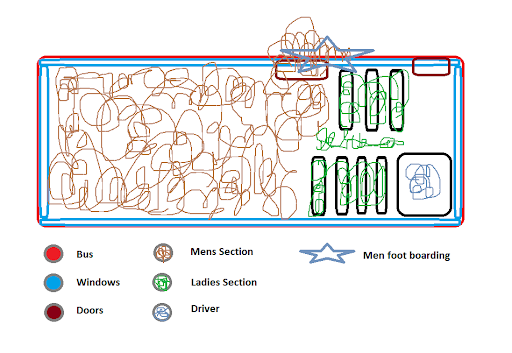
A few weeks back I was sitting in the last seat on the left side of the bus, that is reserved for women. Its just before the middle door of the bus.


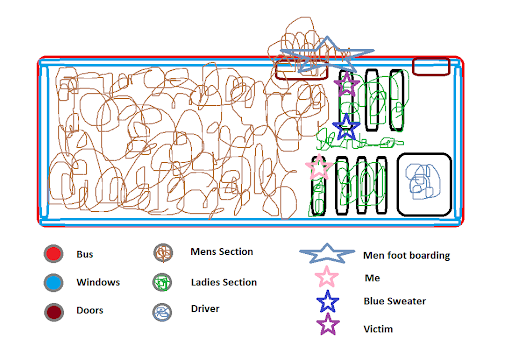
A whole bunch of men were foot-boarding. Their feet were on the door marked above, and a lot of their hands were grasping the window ledge of my seat. A Muslim lady was sitting next to me, by the window and I had the aisle seat. She wore a red jacket, complete with head scarf and full sleeves. One of the men who was foot boarding, had his face nearly in ours. I think he was a little drunk. He was talking loudly, shouting, obviously very excited at the prospect of breaking his skull. He addressed us and said, "Should I leave my hands?! Should I?" I looked at him and considered speaking to him, and then I did. "Aap gir saktha hai," I said. What an idiot, what a blooming idiot. Why would I say such a thing to him? Does he not know that? Doesn't everyone know that? Why would I give the impression that I really care?! Like "care" about him. But for that moment, I thought I had transgressed some class divide and broken some stereotype about grinning roadside-romeos and I sat happy. "Stupid idiots," said the lady sitting next to me. She was right- he began to ask me the same question over and over, "Should I leave my hands?" Then I ignored him.

A few stops down the road, he hopped off. He pinched her and disappeared. "Eyyy," she exclaimed and then said "Stupid idiot fool!" She shut the window. #WinningIdea.

She got off soon enough and another guy who was foot boarding slid the window open from the outside and then wedged his fingers in to open it further. I shut it definitively. For a moment I worried I had jammed his fingers.

Muslim Lady 2 then took the seat that Muslim Lady 1 had vacated. This lady was fully covered, no reds and lipsticks even, unlike #1. She wore a black burka and a full headscarf. I thought she looked familiar but she didn't seem to think the same about me. She opened the window. I wondered if I should tell her to close it.

But then I'd have to explain the whole story and I may not be able to. Besides, you and I both know that shutting windows is not really a "Winning Idea." So I let it be.

When she motioned for me to move so she could leave, I realised why she looked familiar. There is a lady I cross nearly every morning when I am rushing to catch the bus. She is a sweeper in my building and I think once someone told me she also cooks and I had considered trying her out. Our lines were crossed closer than she knew.

And then I was flooded with questions- Shouldn't I have told her to close the window? She is a sweeper in my building- I kind of know her… As if it changes anything.

*************

So this evening, as I wondered what I would do if a repeat incident occurs, I suddenly stopped my thoughts and told myself, "Stop being silly, can’t think like this all the time."

Then I began to eat my packet of chips and concentrate on other more important things- This flavour used to be called "Caribbean sweet something" and now its called "West Indies sweet something." Why did they change the name? To identify with the cricket fans or what?

Someone was playing Kolaveri Di on his mobile phone (It was coming from the depths of the sweaty masses of men). I wondered what it would be like if I began to sing Kolaveri Di.. "Wouldn't everyone smile? What if everyone began to sing it.. Like a flash mob! What a Pepsi/ Coke-ad moment! "What a transgression of cultural divides." This Kolaveri Di is really such an social equaliser… Hmm.. Should I blog about this song?"

And then it happened. I noticed some rapid movement in the seat across from me.

It was the last seat on the left side of the bus, that is reserved for women.

A girl in a blue sweater was sitting in the aisle seat, where I had been sitting a few weeks back. She was speaking to the girl next to her and had her arm around her. I couldn't see the other girl's face but her head was bent down. Blue Sweater told the Conductor, "You should have closed the door. Why do you leave the door open?" I tried to figure out what was going on and then I tapped her on the shoulder. "Some guy touched her. He was holding on to the window," she said. "Is she crying?" I actioned. "Yea," she mouthed. "Same thing happened to me few weeks back," I told her.

"That's why I was telling Conductor he should keep the door shut," she told me.


*************

Earlier this evening, I was at a book store. My friend stepped out for a minute and came back in to report, "This auto guy asked me if I want a chick." Apparently the pimp asked my friend first if he wanted an auto and then if he wanted "Ladies, Drinks or Disco."
How is the stereotype Men? How is it?


How does it work for you Men? You pinch a woman's shoulder or lean into her and that gives you a kick huh? "Kissed the girls and made them cry" huh George? Foot boarding and feeling up women, is all the same thrill for you?

Would you climax if we did this?


*************

Sometimes when I'm stuck in traffic, auto guys who are ahead of me will turn back and stare. Ok, let me contextualise this. If a man looks, its ok, its nothing bad. So if we were both stuck in traffic but going in opposite directions, and our eyes met, even lingered, its ok. But when we are both facing the ass of some truck in front of his, but he inconveniences his neck to look at me, and stare, that is not ok. So I feel like I should stare back, I can do this. But I can't and he wins. Sometimes I feel like I should probably give them the finger. But he is probably the kind of guy who won't know what it means. Or if he did, he would say, "Come on baby, how is the location?"


*************

Tomorrow when you meet me, you may feel like you need to talk about this and maybe other stories of your own. But don't because I will be like, "Whatever." I mean, a man's got to do what a man's got to do.

When Blue Sweater left, she turned back and said, "Take care." So I did. I clenched my fists… and put my knees together. Then I drew my bag closer to me and adjusted my dupatta.

I have walked home on that road a thousand times. I love it in the day time- These trees are majestic. But in the night, these same familiar and awe inspiring trees, appear wizened and dangerous. I don't plug in my ear phones to play music because it doesn't seem like a good idea. Not today.


Sunday, 4 December 2011

Tradable Commodities

Yesterday a man gave a lecture and said, "I have a new idea. I will be excited for you to join. Its in the field of education. Education industry and the health industry, will never take a hit from the recession. Now is the time."
Commodity 1- Social Services

Commodity 2- Ego Massages

Today I found a website that sells street-stuff like bags and scarves, but marked up about eight times. I could be wrong, but I daresay it is for the artists who make them, claimed by the website to be "tribal artists" but in all likelihood for the middlemen, cashing in on e-commerce.
Commodity 3- Gullible Artisans

A month and a day ago, I found a website that was selling exotic animals. It was very fishy but it was apparently also very possible.
Commodity 4- Anything

Monday, 28 November 2011

Bag of Problems

I have been taking a cloth bag for my grocery shopping, for so long now...

There is this supposedly green option...

... that I have no more plastic bags to throw my garbage in!

This one is not an option- garbage has to be tied securely in plastic

Now the next time I go shopping, I will have to pick up plastic bags in a hurry. I will bag fewer things in single packets, just so I can stock up on packets at home.

I never wanted to admit this.

But the way we live, city folk just cannot solve the climate crisis.

"I am not a Plastic Bag"- denial much?

Friday, 14 October 2011

Link Ups- The Process of Mental Tagging

What do Kushal’s girl friend and Mayur’s girl friend have in common? They are remembered for their one time boyfriend, and they can’t stop it. They can’t create an alternate identity. Whenever they are remembered, it will be by their association with something else, and usually only one of it. Its not so bad if you are an athlete or a dancer, because then of course you should be remembered primarily for your art if that is what you set out to do. Unless your Tiger Woods.... But the case is much the same with one-hit-wonders or journalists who get stuck in a particular beat- they can't shake it off.

We are currently in a public process of linking up and hand cuffing and indeed it is getting a little violent. This is a mass project of ‘tagging’ people. Arvind Kejriwal’s Wiki page could have been tagged under ‘RTI,’ but due to his association with the Lokpal, he will now always be tagged under ‘anna’ as well if not more often and only.

Prashant Bhushan got beaten up yesterday. It was to do with his remarks on Kashmir.

The men who beat him up, are members of Hindu extremist groups and are now targeting Bhushan’s colleague as well- Anna Hazare. The two were spotted together on several occasions, earlier this year.

But Hazare gained recent prominence due to his views on corruption... not Kasmir..

The guys who beat up Bhushan dont really care about that detail. For them, by the tagging system, Bhushan=Hazare, and now Bhushan/Hazare said something about Kashmir, so if A=B and B=C then A=C!

So they want Hazare to make clear his colleague's remarks on Kashmir and comments going around are hoping for Hazare to give some indication of his own view on the issue as well.

This is a dangerous line for Hazare to walk. Soon, all kinds of people are going to ask him all kinds of questions and their support for the anti-corruption movement will take a back seat to their communal agendas- Just like the Egyptian blogger Mikael Nabil Sanad, on a hunger strike (coincidence!) for being censored. Support for him has broken down after he made public his views on Israel. Hazare should have anticipated that his opinion is going to be sought on everything now that he has propped himself as the moral guardian of the nation. Since he cares for India so much, the hope is that he will always have an opinion, or better still, can pull a ‘fast-one.’

To add, Hazare recently released a video asking people not to vote for the UPA. This, along with his previous comments on Modi and link ups with the BJP, Ramdev and Agnivesh, got him tagged with the ‘Hindu right’ and he was alleged to be a tool by the ‘Opposition’ against the Congress.

News reports however say that the Hazare’s supporters who were beaten up, were shouting anti-BJP AND anti-Congress slogans yesterday.

Then this beat-up happened... True that no one beat up Hazare, but associations are going to be made by the press and the public, and Hazare is soon going to be untagged from ‘BJP’ because BHUSHAN was beaten up.

So now suddenly, Hazare’s political stance is back at being apolitical and/or neutral, and we can once again re-tag him under ‘civil society’ by his own creation of the politician-civil society binary.

In one of the more unlikely link ups, Bhushan’s remarks on Kashmir, have provided fodder for small talk between Arundhati Roy and himself, should they ever meet! She said similar things about Kashmir, only then there was this big furore about sedition.. Bhushan hasnt met that response. I dont know, but I’m guessing its the Anna aura/ tag that helped.

Except that this link up is quite fragile- they both differ terribly in their views on Hazare. Some tags are just bigger than others. This couple wont last and this link up wont go very far.